Independent K–12 guidance
School Security Products and Technology: Independent Guidance for K-12 School Leaders
School security products and technology can play an important role in protecting students, staff, and schools. But technology is not a school safety strategy by itself.
Access controls, classroom locks, visitor management systems, surveillance cameras, weapons detection systems, panic buttons, emergency communications technology, artificial intelligence, drones, and other security products must be evaluated within the broader context of a school's risks, people, policies, procedures, training, staffing, supervision, emergency preparedness, and day-to-day operations.
The critical question for school leaders is not simply, What technology can we buy?
Better questions include: What problem are we trying to solve? What independent evidence supports the proposed solution? What are its limitations and potential unintended consequences? What people, policies, training, and secondary response will be required to make it work? And can the district sustain it over time?
National School Safety and Security Services provides independent, non-product-affiliated analysis to help superintendents, school boards, administrators, and safety leaders separate evidence from marketing claims and make informed, practical, and defensible school security decisions.
School Security Technology Should Support a Comprehensive Safety Strategy

There is no single product, technology, program, or piece of security hardware that can make a school safe.
Effective school safety requires layers. Physical security and technology can be important parts of those layers, but they must work alongside strong leadership, active supervision, situational awareness, access and visitor procedures, threat assessment and reporting, student support, emergency preparedness, communications, training, relationships with public safety partners, and consistent implementation.
The effectiveness of a security product also depends heavily on what happens around it.
Who monitors the camera? Who responds when an alert is generated? Who checks a door that is found unsecured? What happens when an employee activates a panic button? Who conducts secondary screening when a weapons detection system alerts? Are substitute teachers trained? Are policies actually followed during arrival, dismissal, lunch, athletic events, and other high-activity periods?
These are human and operational questions, not technology specifications.
The strongest school security strategy integrates products and technology with people, policies, procedures, training, supervision, communication, and leadership.
School Access Control, Visitor Management and Door Security

Access control is one of the most fundamental components of school security, but access control is a system, not simply an electronic lock, camera, card reader, or secured vestibule.
Schools should establish clearly defined entrances, control exterior doors, direct visitors to designated entry points, maintain effective visitor procedures, monitor access throughout the school day, and train staff to recognize and address unauthorized or suspicious persons.
Technology can support these practices. Electronic access controls, visitor management systems, intercoms, cameras, door alarms, and other systems can help staff manage school access. But technology cannot compensate for doors that are routinely propped open, employees who allow unknown persons to follow them into buildings, inconsistent visitor procedures, or staff who assume someone else is responsible for addressing an unsecured door.
What About Classroom Door Locks?
Classroom door security has received significant attention following school shootings. Schools should have functional classroom door hardware that allows staff to quickly secure rooms during an emergency.
That does not automatically mean that every classroom door should be closed and locked during every minute of instruction.
School leaders should distinguish between the value of having reliable, quickly lockable classroom doors and mandates requiring teachers to teach behind locked doors throughout the entire school day. Decisions should consider everyday school operations, supervision, student movement, emergency procedures, building design, special-needs populations, implementation realities, and the evidence used to support proposed mandates.
Important distinction: Door locks are physical security controls. Lockdown is an emergency response strategy. School lockdown planning and training should be addressed as part of the school's broader emergency preparedness program.
Metal Detectors, AI Weapons Detection and School Screening

Do Weapons Detection Systems Make Schools Safer?
Traditional metal detectors have been used for decades in some schools, particularly in larger urban districts. More recently, companies have marketed artificial intelligence and other weapons detection systems as faster, less intrusive alternatives.
The technology has changed. Many of the fundamental implementation questions have not.
Weapons screening can require significant staffing, training, equipment, secondary screening procedures, controlled entry points, maintenance, calibration, and ongoing supervision. School leaders also need to consider student arrival patterns, buses, athletics, extracurricular activities, backpacks and personal belongings, visitors, multiple entrances, late arrivals, false alerts, bypass opportunities, and what happens when the system identifies something requiring further investigation.
A technology's ability to detect an object under controlled conditions is not the same as demonstrating that a screening program will prevent weapons from entering a school under real-world operating conditions.
Schools considering weapons detection should examine both what a system can detect and what it may miss, as well as the human processes required after an alert.
Our longstanding analysis of traditional and newer weapons detection systems examines these operational issues and the questions school leaders should ask before making significant investments.
Panic Buttons, Emergency Alerts and School Communications Technology

Panic buttons, wearable duress devices, mobile emergency applications, mass notification systems, two-way radios, staff cell phones, and other communications technologies can help schools communicate during emergencies.
But faster technology does not automatically produce faster or better emergency decisions.
When evaluating emergency alerting technology, school leaders should ask:
- Who can activate an alert?
- Under what circumstances should it be activated?
- What information does the alert communicate?
- Who receives it?
- What do recipients believe the alert means?
- Does it automatically contact law enforcement or other responders?
- What happens after activation?
- How are accidental or inappropriate activations handled?
- How are employees trained?
- How is the system tested?
- What backup communication method exists if the primary system fails?
A panic button is ultimately an alerting tool. Its effectiveness depends on the people, procedures, training, communications, and emergency response actions that follow the alert.
Mandates can make these questions even more important. When policymakers require a specific technology across thousands of schools with different facilities, staffing, risks, and operating conditions, the policy discussion should include evidence of effectiveness, implementation requirements, costs, actual patterns of use, and unintended consequences.
Cameras, Video Surveillance, Artificial Intelligence and Detection Technology
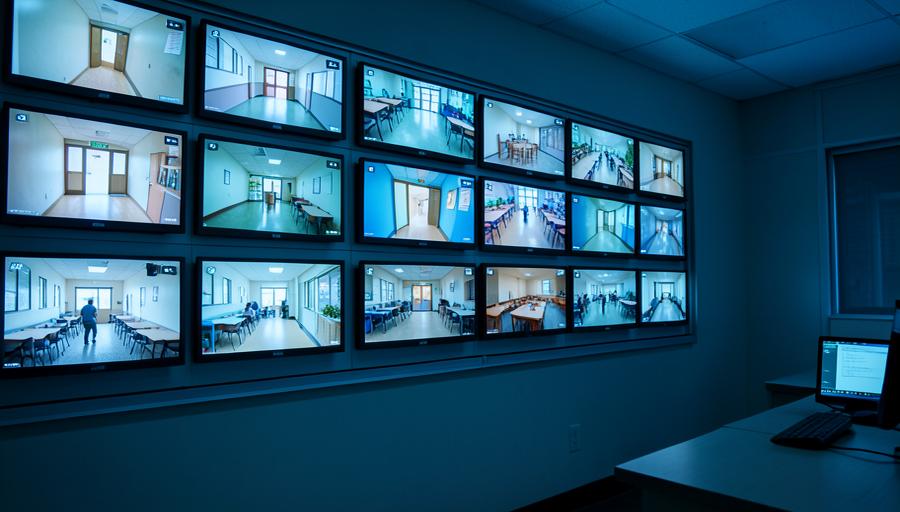
Security cameras have long been among the most common technologies used in schools. Newer systems increasingly incorporate video analytics, artificial intelligence, automated detection, and other capabilities intended to identify potentially concerning activity.
School leaders should be precise about what these systems actually do.
A camera may provide valuable documentation after an incident. Live monitoring may help personnel identify a developing problem. Analytics may draw attention to specified activity. Artificial intelligence may generate an alert.
But none of those functions automatically means that the technology prevents an incident.
The questions school leaders should ask include: What exactly is being detected? How accurately? Under what conditions? Who receives the alert? How quickly is it reviewed? What action follows? What are the false-positive and false-negative rates? What privacy, policy, data, and cybersecurity issues are created? What happens when the technology works as designed but the human response does not?
Technology specifications tell only part of the story. The entire detection-to-response process must work.
Emerging and Experimental School Security Technology

School security is an expanding marketplace. New products increasingly incorporate artificial intelligence, biometrics, advanced sensors, drones, robotics, automated surveillance, and other technologies.
Innovation should not be rejected simply because it is new. Neither should novelty be confused with effectiveness.
When a technology has limited independent research or limited real-world K-12 experience, school leaders should apply more scrutiny, not less.
Questions should include:
- Was the technology originally designed for schools?
- What independent evidence supports its use in K-12 environments?
- Has it been tested under realistic school conditions?
- What problem does it solve better than existing practices?
- What new risks does it introduce?
- What happens when it fails?
- What human intervention remains necessary?
- Are schools being asked to become test sites for an unproven security concept?
Just because a technology exists does not mean it belongs in a school.
School Police and Security Officer Equipment

Technology and equipment used by school resource officers, school police, security officers, and other public safety personnel present additional considerations.
Tools appropriate in traditional law-enforcement environments may create different operational, policy, legal, developmental, and school-community considerations when introduced into K-12 settings.
Administrators should understand what equipment is being used in their schools, applicable policies and training, use-of-force considerations, the responsibilities of the school district and law-enforcement agency, provisions of memoranda of understanding, and how equipment may affect students, including students with disabilities or special needs.
These are not decisions that should automatically be delegated without school leadership awareness.
Does School Security Technology Actually Work?

One of the most important responsibilities of school leaders is distinguishing evidence from assertions of effectiveness.
Anecdotes are not evidence
A district can install a security product and subsequently experience no major act of violence. That does not demonstrate that the product prevented violence.
Likewise, a product being present during a successful emergency response does not necessarily demonstrate that the product caused the successful outcome.
Correlation is not causation
School safety claims frequently confuse things that occurred together with evidence that one caused the other.
School leaders should ask what was actually measured, what alternative explanations exist, whether comparable groups were studied, and whether conclusions extend beyond what the evidence supports.
Vendor-funded research requires context and transparency
Industry-funded research is not automatically invalid. Vendors and manufacturers can contribute legitimate expertise, data, and innovation.
But school leaders deserve to know who funded research, who designed it, what outcomes were measured, what limitations exist, and whether the conclusions accurately reflect the findings.
Laboratory performance is not real-world school performance
Schools are complex environments.
Students arrive in large groups. Employees become distracted. Doors are propped. Substitute teachers work in buildings they barely know. Technology generates false alerts. Staffing changes. Equipment needs maintenance. Weather affects arrival procedures. Students carry bags, instruments, laptops, water bottles, and countless personal items. Behavioral incidents occur at the same time staff are performing security responsibilities.
Products need to work in schools as they actually operate, not simply under ideal conditions.
Fidelity of implementation matters
Even a technically sound product can perform poorly when staffing, policies, training, maintenance, supervision, or follow-through are inadequate.
School safety is not a plug-and-play activity.
Security Theater and the School Safety "Shiny Object" Problem

After a school tragedy, communities understandably demand action. Parents want reassurance. School boards face pressure. Legislators want solutions. Administrators are expected to demonstrate that something is being done.
Highly visible security products can be attractive in these environments because people can see them.
A new camera system can be photographed. A weapons detection system can be demonstrated. New hardware can be announced. A technology purchase gives leaders something tangible to point toward.
But visibility is not the same as effectiveness.
Some of the strongest school safety practices are comparatively invisible: active supervision, trusted relationships between students and adults, situational awareness, threat assessment, effective communications, employee training, emergency planning, student support, and staff members willing to question something that does not look right.
Security products can appropriately support these practices. Problems arise when the appearance of security substitutes for the harder work of creating effective safety systems.
Who Is Selling the Solution? Vendor Influence, Evidence and Due Diligence

The school security marketplace includes manufacturers, technology companies, systems integrators, consultants, professional associations, nonprofit organizations, investors, conference sponsors, researchers, and other organizations.
There is nothing inherently wrong with companies earning money by providing legitimate products and services to schools. Schools need locks, cameras, communications systems, access controls, radios, software, and other security products.
But school leaders should understand who is providing the information influencing their decisions.
Selling can increasingly be packaged as education. Marketing can resemble thought leadership. Vendor-funded research can be presented as independent evidence. Sponsorships and partnerships can create credibility. Former practitioners may become paid representatives or advisers. Nonprofit organizations, conferences, webinars, standards initiatives, and professional networks can have financial relationships with companies whose products are being discussed.
The issue is not whether industry participates in school safety discussions. Industry expertise can be valuable.
The issue is transparency, independence, balance, and disclosure.
Before relying on recommendations, school leaders should consider:
- Who developed the guidance?
- Who funded the research or organization?
- Does the author or speaker have a financial relationship with a vendor?
- Does a nonprofit receive money from companies whose products it discusses?
- Are industry representatives disproportionately shaping standards or recommendations?
- Is sponsored content clearly identified?
- Are alternative perspectives represented?
- Is the person recommending a product also selling, representing, investing in, or otherwise benefiting from its adoption?
Independent judgment becomes especially important when safety, significant public expenditures, and potential liability are involved.
Related Independent Analysis
Security Standards and Guidelines Are Not All the Same

School leaders encounter standards, guidelines, best-practice documents, checklists, frameworks, and recommendations from many sources.
They should understand what each document actually represents.
A government publication, consensus standard, industry guideline, vendor white paper, nonprofit recommendation, academic research study, and professional opinion are not interchangeable simply because each discusses school security.
Administrators and boards should consider who developed a standard or guideline, who participated in the process, whether school practitioners were adequately represented, what evidence supports the recommendations, whether commercial interests are involved, and what financial and operational consequences implementation could create for schools.
No publication should automatically become a substitute for a school-specific assessment, professional judgment, local risk analysis, or thoughtful leadership.
ASIS School Security Standard Analysis
Human Factors: Technology Is Only as Effective as Its Implementation

Some of the most consequential school safety failures do not begin with broken technology.
They begin with people.
A door is left open. An alert is misunderstood. A radio is unavailable. A policy exists but employees do not follow it. A camera captures an incident but nobody is monitoring it. Staff members assume someone else will respond. Training occurred once but was never reinforced. A system works technically, but the organization around it does not.
This is why investments in school security technology must be accompanied by investments in people, supervision, situational awareness, training, communication, leadership, and implementation fidelity.
From the schoolhouse to the courthouse, the recurring lesson is that technology cannot compensate for failures of supervision, training, communication, policy, judgment, and implementation.
The human side of school safety remains both one of our greatest strengths and one of our greatest vulnerabilities.
Frequently Asked Questions About School Security Products and Technology
There is no universal list of security products appropriate for every school. Technology decisions should be based on school-specific risks, vulnerabilities, facilities, staffing, operations, existing safeguards, available resources, and the problems leaders are trying to solve. Common technologies include access control, communications systems, cameras, visitor management, alarms, and other security systems, but each should support a broader safety strategy rather than substitute for leadership, supervision, training, and preparedness.
No single security product can guarantee prevention of a school shooting or other act of targeted violence. Some technologies may reduce particular vulnerabilities, provide earlier notification, improve communications, delay unauthorized access, or support emergency response. Claims that a particular product ‘prevents school shootings’ should be carefully scrutinized. Prevention depends on multiple layers, including reporting, threat assessment, student support, supervision, access control, trained personnel, emergency preparedness, communication, and effective implementation.
AI and other newer weapons detection systems may provide capabilities different from traditional metal detectors, but effectiveness depends on what the system is designed to detect, sensitivity settings, staffing, secondary screening, controlled entry points, training, maintenance, and implementation fidelity. School leaders should examine independent evidence, real-world school performance, false positives and false negatives, items the system may not detect, staffing requirements, throughput, costs, and unintended operational consequences before adopting such systems.
Schools should have functional classroom doors that staff can secure quickly during emergencies. Whether classroom doors should remain closed and locked throughout every minute of the instructional day is a separate policy question. Leaders should consider building design, supervision, student movement, instructional operations, special-needs populations, emergency procedures, implementation realities, and the quality of evidence supporting proposed mandates rather than treating one practice as universally appropriate for every school.
Panic buttons can provide a rapid means of communicating an emergency, but whether a particular school or district needs them should be determined through risk assessment and operational analysis rather than assumptions or marketing claims. Leaders should evaluate who will activate them, what circumstances justify activation, who receives the alert, what response follows, training and testing requirements, accidental activations, recurring costs, and how the technology integrates with existing communications and emergency plans.
Boards should begin by clearly defining the problem they are trying to solve and then examine multiple possible solutions. Evaluation should include independent evidence, product limitations, total costs, staffing and training requirements, implementation challenges, privacy and policy implications, potential unintended consequences, vendor history, financial and organizational relationships, and how effectiveness will be measured. School leaders should distinguish independent guidance from marketing, sponsored content, testimonials, and vendor-funded research.
Need an independent evaluation of your school's safety and security needs?
School Safety and Security AssessmentsLooking for strategic guidance on school safety leadership and decision-making?
Strategic School Safety Leadership Consultations